A historical narrative
David of Tao's world, imperial crisis, Tornike's intervention and the historical setting of Iviron.
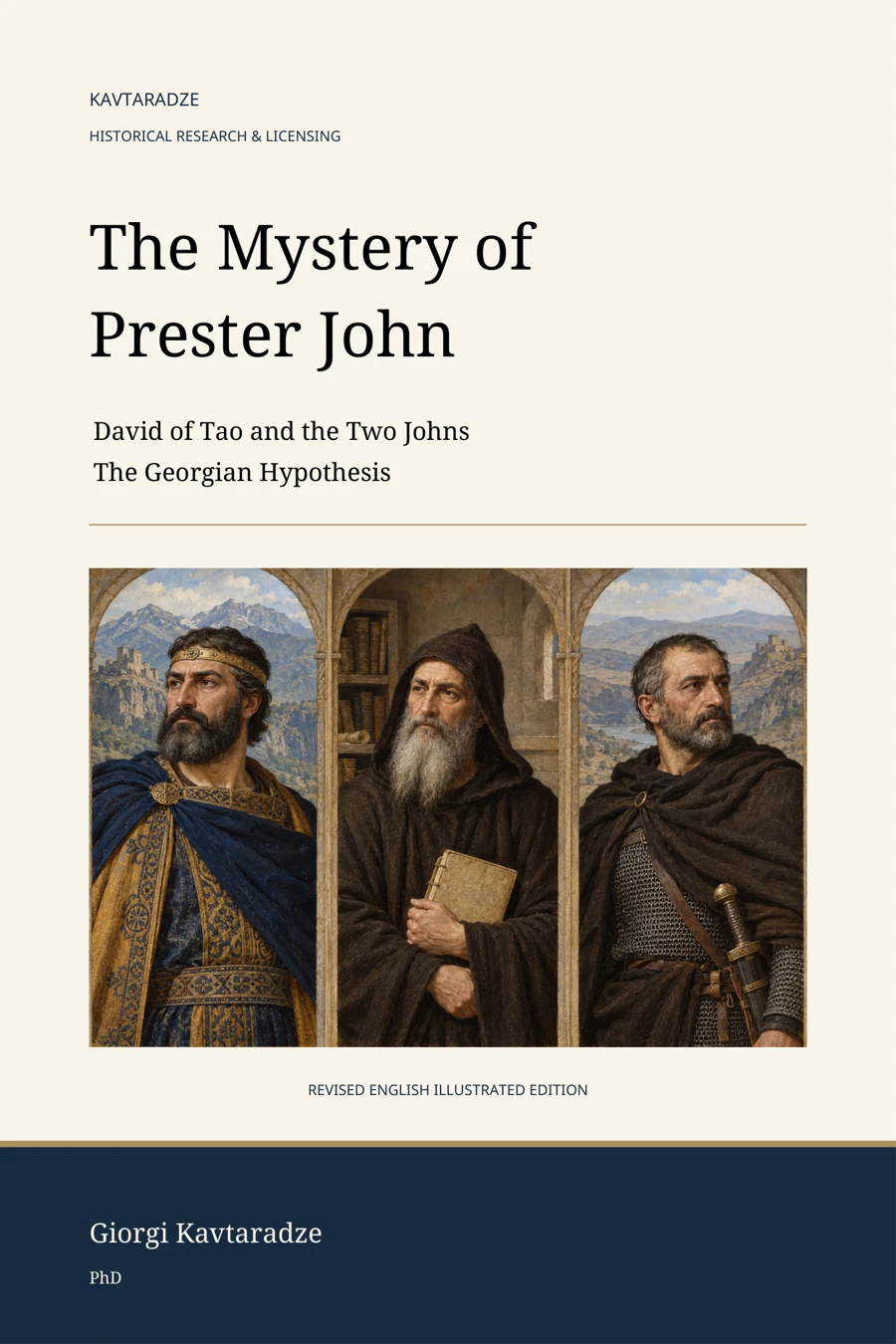 Revised English edition · 2026
The history behind the legend
David of Tao and the Two Johns:
The Georgian Hypothesis
Where did the story of the priest-king who captivated the medieval imagination begin?
This investigation turns to the tenth century: David III of Tao, John-Tornike and John the Iberian, before following the question into the world of medieval legend.
English edition · PDF
Read the free sample18 pages, including the cover and both depictions of Basil II.
Opens in a new tab. No purchase is needed.
Complete English edition
$14.90PDF · 118 pages
Email your order to
The button opens a prefilled message in your email app. You can also copy the address and write from any email service you prefer.
Business days are Monday–Friday, excluding public holidays in Georgia.
The central question
By the time Otto of Freising writes about Prester John, the story is already legendary. What might lie behind that account?
Giorgi Kavtaradze develops a Georgian hypothesis centred on the shared historical world of David of Tao, John-Tornike and John the Iberian. The narrative moves between Georgia, Byzantium and Mount Athos, then turns to the western accounts of a distant priest-king.
This revised edition begins with documentary attestations of Johns called presbyter. It compares the shared historical world of David of Tao, John Tornike and John the Iberian with Otto of Freising’s account, examining Skleros’s eastern connections and alternative explanations. Documented names and events are distinguished from the still unproven transmission of their memory into the legend.
Inside the edition
David of Tao's world, imperial crisis, Tornike's intervention and the historical setting of Iviron.
Surviving images appear alongside explicitly labelled reconstructions, maps and architectural settings.
110 notes, 50 bibliography entries, the author’s photograph of the Zarzma inscription with transcription and analysis, and a facsimile of the 1047 colophon.